You hit the nail on the point
Posted: January 3, 2025 Filed under: Uncategorized | Tags: expressions, humor, language, malaphors, mixed idioms, wordplay, words Leave a commentThis malaphor was overheard in a Zoom meeting where the contributor’s boss was talking to a consultant who is helping the company increase sales. This is a mashup of “hit the nail on the head” (precisely correct or accurate) and “to the point” or “on point” (focused on or related to the crux of a particular topic). “Hitting the nail on the head” seems to get messed up a lot. For example, I have posted other variations such as “You hit the nail on the button” https://malaphors.com/2022/05/02/you-hit-the-nail-on-the-button/ and “You put your finger on the nail” https://malaphors.com/2020/01/02/you-put-your-finger-on-the-nail/.
A big thanks to frequent malaphor contributor Verbatim for hearing this one and sending it in!
Sometimes we clash heads
Posted: November 4, 2024 Filed under: Uncategorized | Tags: idioms, malaphors, pizza, wordplay, words Leave a commentThis was heard on the You Tube video, “Meet the Krispy Pizza Kings of New York”. Here is the link to the video:
This is a congruent conflation of “clash with (someone or something)” and “butt heads”, both meaning to disagree with someone. A huge shout out to Martin Pietrucha for hearing this one and sending it in!
Nimwit
Posted: September 23, 2024 Filed under: Uncategorized | Tags: idioms, mixed metaphors, nimrod, wordplay Leave a commentA YouTuber was describing a dumb politician and used this word. It is a word blend congruent conflation of “dimwit” and “nimrod”, both terms describing a stupid person.
The idiom “nimrod” doesn’t seem to be used often these days. The usage perhaps was first recorded in an 1836 letter from Robert E. Lee to a female friend. Lee describes a “young nimrod from the West”, who in declining an appointment to West Point expressed the concern that “I hope my country will not be endangered by my doing so.” Although Lee may have been sarcastically referring to the student as a “tyrant or skillful hunter”, the modern usage more closely fits his message. The usage is often said to have been popularized by the Looney Tunes cartoon character Bugs Bunny sarcastically referring to the hunter Elmer Fudd as “nimrod” to highlight the difference between “mighty hunter” and “poor little Nimrod”, i.e. Fudd. However, it is in fact Daffy Duck who refers to Fudd as “my little Nimrod” in the 1948 short “What Makes Daffy Duck“, although Bugs Bunny does refer to Yosemite Sam as “the little Nimrod” in the 1951 short “Rabbit Every Monday“.
A big shout out to Verbatim for hearing this one and sending it in.

I’m always spinning my tail
Posted: July 26, 2019 Filed under: Uncategorized | Tags: chasing my tail, expressions, humor, malaphor, spinning my wheels, wordplay, words Leave a commentThe speaker was lamenting about his unproductive efforts. This is a classic congruent conflation of “spinning my wheels” and “chasing my tail”, both meaning to take action that is ineffectual or does not lead to progress. The speaker may have had an image of a cat or dog spinning around trying to catch his tail. A tip of the hat to Steve Grieme who heard this one uttered by a friend and passed it on.
I’m worried stiff
Posted: February 4, 2019 Filed under: Uncategorized | Tags: Chris Hayes, humor, language, malaphor, MSNBC, scared stiff, wordplay, worried sick Leave a commentHeard on the MSNBC show with Chris Hayes. This is a conflation of “scared stiff” (utterly terrified) and “worried sick” (very concerned about a person or situation). I have heard this one a lot. “Sick” and “stiff” are similar sounding words, contributing to the mashup. A big thanks to Frank King for hearing this one!
If you liked this one, check out my book on malaphors, “He Smokes Like a Fish and other Malaphors”. It’s available on Amazon for a cheap $7.99. Just click on the link – https://www.amazon.com/dp/0692652205

Smart as a tack
Posted: February 1, 2019 Filed under: Uncategorized | Tags: expressions, malaphors, sharp as a tack, smart as a whip, wordplay, words Leave a commentThis is an example of a perfectly formed malaphor. It is a congruent conflation (the best kind of malaphor, imho) of “smart as a whip” and “sharp as a tack”, both describing someone as highly intelligent. Smart and sharp are similar sounding words, and both idioms contain the “as a” words. Also, if you sit on a tack, it does smart, doesn’t it? The mashup is also heard in the Adam Sandler movie, “Big Daddy”. Here’s the clip:
A big thanks to Martin Pietrucha who heard this one and sent it in.
My mother could dance you under the table
Posted: January 31, 2019 Filed under: Uncategorized | Tags: dance up a storm, drink you under the table, humor, language, malaphor, wordplay 2 CommentsThis one was heard at a retirement party for an organist/choirmaster. In recounting her history, the organist talked about how her mother had a great sense of rhythm, which she inherited. This is a mashup of “dance up a storm” (dance with intensity) and “drink you under the table” (to be able to drink more alcohol than someone else). Drinking and dancing both start with the letter “d” and both actions are often both associated together, hence the mix up.
The phrase appears in the Urban Dictionary with a decidedly different definition. https://www.urbandictionary.com/define.php?term=Danced%20Her%20Under%20The%20Table. A tip of the hat to Barry Eigen, who heard this one and submitted it to Malaphor Central.
Starting to make a turn back?
Posted: January 30, 2019 Filed under: WORD BLENDS | Tags: humor, language, malaphor, Trump, wordplay, words Leave a commentThis is a word blend of “”turnaround” ( a complete change in opinion or method) and “comeback” (a return to popularity). As I have noted before in previous posts, malaphors can be word blends or idiom blends. The word blend seems to be a less common phenomenon.

This is the big, 40,000 foot question
Posted: January 28, 2019 Filed under: Uncategorized | Tags: 000 dollar question, 000 foot view, expressions, Here and Now, humor, idioms, malaphor, NPR, Roger Stone, the 10, the 64, Tim Mak, Trump, wordplay, words Leave a commentTim Mak, NPR political reporter on the NPR radio show, Here and Now, was discussing the recent indictment of Roger Stone. He was retelling what was in the indictment, but questioning what evidence Special Counsel Robert Mueller has in his possession. This gem can be heard at 5:15 of the following:
https://www.wbur.org/hereandnow/2019/01/25/roger-stone-indicted
This is a wonderful conflation of “the 64,000 dollar question” (a question very important and/or difficult to answer) and “the 10,000 (or sometimes 20, 30, or 40,000) foot view” (a description of a problem or issue that provides general information, but short on details). Idioms containing numbers are often jumbled. I have posted some other great ones, such as “hindsight is 50/50” (https://malaphors.com/2016/12/20/hindsight-is-5050/) and “we were 3 sheets passing in the night” (https://malaphors.com/2016/10/25/we-were-3-sheets-passing-in-the-night/). A big thanks to Tom Justice for hearing this one and sending it in!

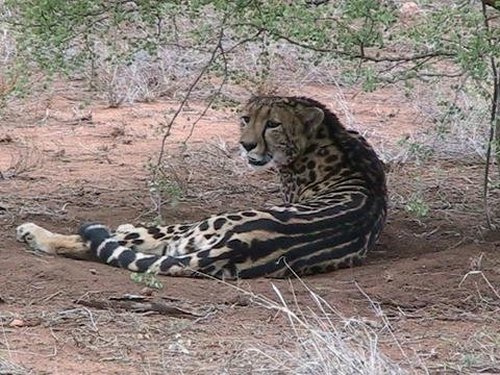
You can’t get a leopard to change his stripes
Posted: January 23, 2019 Filed under: Uncategorized | Tags: a leopard cannot change its spots, a tiger cannot change its stripes, expressions, humor, malaphor, wordplay, words 2 CommentsThis was uttered by an employee commenting on a work group that seem set in its ways. It is a nice congruent conflation of “a leopard cannot change its spots” and “can’t change one’s stripes”, both meaning that people are incapable of changing their essential nature. The speaker might also have been thinking of the expression “a tiger cannot change its stripes”, meaning the same as the two expressions above. Confusing tigers and leopards is certainly understandable, both being big cats. A big thanks to Steven Michael for hearing this one!

 Malaphors
Recent Comments